
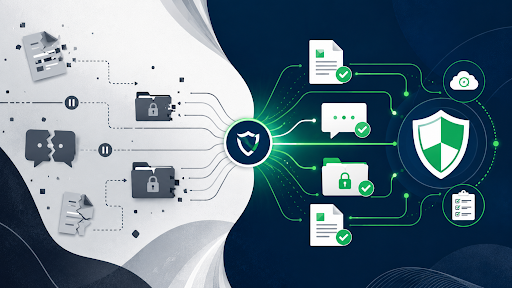
The Number Gets Attention. The Real Story Is What Happens After the Attack.
The claim that 60% of small businesses close within six months of a cyberattack has been repeated for years. It is a powerful line because it turns cybersecurity from a technical issue into a survival issue. But for businesses looking for cybersecurity services Des Moines, the smarter move is not to use that number as a scare tactic. The smarter move is to understand what the statistic is really pointing toward: many small businesses are not prepared for the operational, financial, and reputational damage that can follow a serious cyber incident.
The exact 60% figure has been debated, and the National Cybersecurity Alliance has publicly noted concerns about how the statistic has been attributed and repeated. Still, the warning behind it should not be ignored. A cyberattack can interrupt operations, lock employees out of systems, delay customer service, expose sensitive data, create recovery costs, and damage trust. For a small or mid-sized business, those effects can create pressure quickly. The real question is not whether every business will close after an attack. The real question is whether your business is prepared enough to keep moving when systems, data, people, and customers are all affected at once.
The Attack Does Not Feel Like a Business Crisis Yet
Most cyber incidents do not begin with a dramatic warning. They often start quietly. An employee clicks a link that looked legitimate. A password gets reused. A remote login happens from an unusual location. A cloud folder is shared too broadly. A device misses critical updates. A backup job fails in the background.
At first, the business may not notice anything. Email still works. Files still open. Customers are still being served. Leadership has no reason to believe something serious is happening. That is exactly why cyber risk is dangerous. The early stage of an incident can be invisible to the people making business decisions. Cybersecurity services help close this visibility gap. Monitoring, endpoint protection, access control, email security, and alert review give the business a better chance of spotting trouble before it grows. Without that visibility, a small compromise can quietly become a larger disruption.
Day 1: The Business Starts Losing Control of Its Time
The first visible day of a cyberattack is usually defined by confusion. Someone cannot access files. A staff member receives strange emails. A system behaves differently. A customer asks about a suspicious message. A manager realizes that an account may have been compromised. This is where many businesses lose time. Employees pause their work. Managers ask who should be contacted. IT tries to determine whether the issue is isolated or spreading. Leadership starts asking whether customer data is involved. If the company does not have a clear response process, every decision takes longer.
That is why an incident response plan matters. NetStandard’s related blog, Lessons to Learn from the CrowdStrike Outage, explains the importance of clear response steps, communication, containment, and recovery planning after major technology disruptions. For small businesses, the same idea applies: the faster the company can organize its response, the less time it loses to uncertainty.
Week 1: Downtime Starts Turning Into Business Damage
A cyberattack becomes more expensive when downtime stretches beyond the initial incident. Employees may not be able to work normally. Customers may not receive fast responses. Invoices may be delayed. Appointments may need to be rescheduled. Internal communication may slow down. Leadership may have to focus on recovery instead of growth. This is where cybersecurity becomes a business continuity issue. The damage is not only the attack itself. The damage is the interruption that follows. A business that cannot access its systems, restore data, communicate clearly, or verify what happened can lose momentum quickly.
Strong cybersecurity services reduce this risk by combining prevention with recovery readiness. That includes secure backups, documented systems, access reviews, endpoint protection, cloud security, monitoring, and a plan for restoring operations. A business does not need perfect protection to be better prepared. It needs layers that reduce the chance of a full operational collapse.
Month 1: Trust Becomes Harder to Repair Than Technology
Technology can often be restored faster than trust. Customers, vendors, employees, and partners may start asking difficult questions. Was data exposed? Are systems safe now? Can the company still deliver service? Why did this happen? What has changed since the incident?
These questions matter because business trust is built slowly and damaged quickly. Even if the company recovers its systems, poor communication or unclear recovery steps can leave customers uneasy. This is why cybersecurity should include more than technical defense. It should include planning, documentation, and communication readiness. A well-prepared business can respond with more confidence. It can explain that systems are being reviewed, access has been secured, backups are being used, and additional protections are being implemented. A business without preparation may be forced to communicate while still trying to understand the basics.
Month 6: The Pressure Is Rarely One Single Cost
The reason the “six months” warning resonates is because post-attack pressure often builds gradually. It is rarely one cost that hurts the business. It is the combination of downtime, recovery expenses, lost productivity, customer concerns, emergency support, legal or compliance questions, insurance complexity, and delayed operations. The National Cybersecurity Alliance has stated that the commonly repeated “60% close within six months” statistic has been incorrectly attributed in many places, which is why businesses should avoid treating the number as a guaranteed outcome. But the broader lesson remains useful: cyber incidents can create serious business pressure when organizations do not have preparation, visibility, recovery planning, or professional support. National Cybersecurity Alliance statement on the small business statistic. For Des Moines businesses, the practical takeaway is simple. Do not wait until a cyberattack to discover whether your business can survive one.
What Cybersecurity Services Could Have Changed
The first thing cybersecurity services could change is visibility. If your business can detect suspicious activity earlier, it has more time to respond. Monitoring, endpoint protection, email security, and account alerts can help identify risk before it becomes a full business interruption. The second thing they could change is access control. Many cyber incidents become worse because accounts are too open, permissions are too broad, or former users still have access. Proper user management, multi-factor authentication, and permission reviews help reduce that risk.
The third thing they could change is recovery. Backups should not be treated as a checkbox. They need to be secure, current, and tested. If ransomware, account compromise, accidental deletion, or system damage affects the business, recovery depends on whether the company can restore what matters. The fourth thing they could change is decision-making. During a cyber incident, leadership needs clear guidance. Who should be contacted? Which systems should be isolated? What should employees do? What should customers be told? What needs to be documented? A managed cybersecurity partner helps turn panic into process.
Why Small Businesses Need Practical Cybersecurity, Not Fear
Small businesses do not need fear-based cybersecurity. They need practical cybersecurity. They need protection that matches how they actually operate, how their employees work, what systems they depend on, and what risks would cause the most damage. For some businesses, that means stronger email protection and employee training. For others, it means backup and disaster recovery. For others, it means better cloud security, endpoint protection, compliance support, or account monitoring. The right approach depends on the business, but the principle is the same: cybersecurity must be connected to operations. NetStandard helps Des Moines businesses build that practical approach through cybersecurity services, managed IT, backup and disaster recovery, cloud support, and strategic technology guidance. The goal is not to make cybersecurity feel overwhelming. The goal is to make it more manageable, visible, and tied to real business risk.
The Cybersecurity Question Every Owner Should Ask
Instead of asking, “Could we be attacked?” ask a better question: “What would happen next?” What would happen if your email was compromised? What would happen if customer files were locked? What would happen if your accounting system was unavailable? What would happen if a remote employee’s account was used by someone else? What would happen if backups failed during recovery? These questions reveal whether your business has a security program or only security products. They also help leadership prioritize the right improvements. A business that understands its most important systems can protect them more effectively.
Build Cyber Resilience Before Your Business Is Tested
Cybersecurity should not begin after a breach, a ransomware scare, or a customer complaint. By then, the business is already reacting under pressure. The better approach is to build resilience while operations are normal. NetStandard helps Des Moines businesses strengthen cybersecurity with managed protection, monitoring, backup and disaster recovery, access control, employee awareness, and strategic IT support. If your business has security tools but no clear recovery plan, no tested backups, or no structured response process, now is the time to close those gaps. Contact NetStandard today to build cybersecurity services in Des Moines that help protect your business before every hour starts to matter.
FAQs
Why do small businesses in Des Moines need cybersecurity services?
Small businesses in Des Moines need cybersecurity services because they rely on email, cloud platforms, customer data, business applications, and connected devices. Cybersecurity helps reduce risk, improve response, and protect operations.
Is the 60% small business cyberattack statistic accurate?
The statistic is widely repeated, but its attribution and accuracy have been disputed. The safer takeaway is that cyberattacks can create serious financial, operational, and reputational pressure for unprepared small businesses.
What cybersecurity services help reduce business disruption?
Important cybersecurity services include endpoint protection, email security, account monitoring, multi-factor authentication, backup and disaster recovery, access reviews, employee training, and incident response planning.
Does NetStandard provide cybersecurity services in Des Moines?
Yes. NetStandard provides cybersecurity services for Des Moines businesses, including managed security support, threat detection, compliance assistance, employee security training, backup and disaster recovery, and business-focused IT protection.