
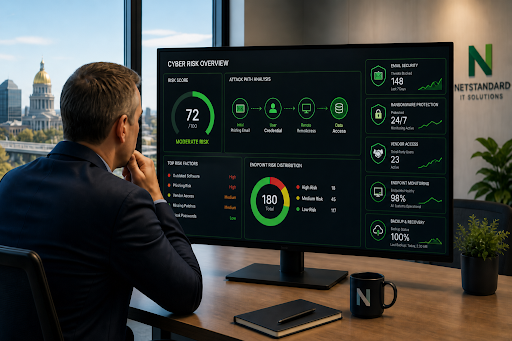
A hacker does not always choose the biggest company in the market. They often choose the company with enough money to pay, enough data to exploit, and not enough protection to slow them down. That is exactly why mid-sized businesses in Des Moines are becoming attractive targets. They may have valuable client records, payroll systems, vendor payments, cloud accounts, and internal workflows, but they may not have the same security budget or dedicated security team as a large enterprise. This is where cybersecurity services Des Moines businesses use become more than an IT expense. They become business protection.
The mistake many mid-sized companies make is assuming they are too small to matter. In reality, attackers do not need your company to be famous. They only need a weak entry point. A compromised email account, an exposed remote access tool, an employee who clicks the wrong link, an outdated system, or an untested backup can be enough to create serious disruption.
Mid-Sized Businesses Sit in the Danger Zone
Large corporations usually have security teams, monitoring tools, legal departments, compliance officers, insurance requirements, and formal incident response plans. Small businesses may have less revenue and fewer systems worth attacking. Mid-sized businesses often sit between those two worlds.
They are large enough to have valuable data, multiple employees, cloud systems, vendor relationships, customer accounts, and recurring payments. But they are often not mature enough to have enterprise-level cybersecurity. That gap is what makes them attractive. A Des Moines manufacturer may have supplier contracts and production schedules. A professional services firm may have client financial records. A healthcare-related company may have sensitive patient or employee information. A construction or logistics business may depend on scheduling systems, job files, invoices, and vendor communication. If those systems are interrupted, the damage spreads quickly.
Hackers Follow Weak Processes, Not Just Weak Technology
Many cyber incidents do not start with advanced hacking. They start with weak business processes. An employee approves a fake invoice. A manager shares credentials over email. A former employee still has access. A vendor portal uses a weak password. A cloud folder has broad permissions. A backup exists, but no one has tested it.
This is why cybersecurity cannot be treated as only a tool problem. Buying security software helps, but it does not fix poor access controls, unclear approval processes, weak onboarding, or rushed employee decisions. Strong managed IT services Des Moines businesses rely on should help close these operational gaps. That means reviewing user access, improving email protection, documenting systems, strengthening passwords, setting up multi-factor authentication, monitoring endpoints, and helping employees understand how attacks actually happen.
Business Email Is One of the Easiest Doors In
For many mid-sized businesses, email is the center of daily operations. It is where invoices are sent, contracts are discussed, files are shared, approvals happen, and client communication lives. That also makes email one of the most valuable attack points.
Business email compromise can be especially damaging because it does not always look like a dramatic cyberattack. A criminal may gain access to one inbox and quietly watch conversations. They may wait for the right moment to send payment instructions, impersonate a vendor, request sensitive files, or trick an employee into changing account details. A company may not notice the issue until money is gone, data has been exposed, or customers start receiving suspicious messages. This is why business email security, multi-factor authentication, employee training, and monitoring should be part of a serious cybersecurity services Des Moines strategy.
Ransomware Targets Operational Pressure
Ransomware works because attackers understand pressure. They know a business needs access to files, systems, schedules, and communication. They know leadership may feel trapped if operations are frozen and customers are waiting.
Mid-sized businesses are often vulnerable because they cannot afford long downtime. They may not have extra teams, duplicate systems, or a mature recovery process. If ransomware locks important files or disrupts systems, the company may face missed deadlines, delayed payments, customer frustration, and employee confusion. The Cybersecurity and Infrastructure Security Agency provides practical ransomware guidance for businesses that explains prevention, response, and recovery considerations. The important point is clear: ransomware planning should happen before an incident, not after the business is already under pressure.
Backups Are Not Enough Unless They Can Restore
Many businesses believe they are protected because they have backups. That confidence can be dangerous if no one knows whether those backups are secure, current, tested, and recoverable. A backup that has not been tested is only a hope. A backup connected to the same environment may also be at risk during a ransomware event. A backup that takes too long to restore may not meet the needs of the business. A backup without a documented recovery plan can create confusion during an emergency.
This is why backup and disaster recovery should be part of cybersecurity planning. Recovery should answer practical questions. What systems are most critical? How quickly do they need to be restored? Where are backups stored? Who is responsible during an incident? How often are restore tests performed? What happens if the office, server, or cloud system is unavailable? Mid-sized businesses do not need theoretical protection. They need recovery plans that work under pressure.
Vendors Can Expand Your Risk
Hackers do not always attack a company directly. Sometimes they look for weaker links around the business. Vendors, software platforms, remote access tools, contractors, and third-party systems can all create risk. A mid-sized company may work with accounting providers, software vendors, marketing platforms, payroll companies, logistics systems, industry portals, and cloud applications. Each connection adds convenience, but it can also add exposure if access is not managed carefully.
Good IT support Des Moines businesses use should include vendor access reviews, secure account setup, permission management, and offboarding processes. If a vendor no longer needs access, it should be removed. If a third-party tool handles sensitive data, it should be reviewed. If outside users can log into company systems, their permissions should be controlled.
Employee Training Should Be Practical, Not Generic
Most employees do not need long cybersecurity lectures. They need practical habits they can use in real situations. They need to know how to spot unusual payment requests, suspicious login pages, fake file-sharing messages, urgent vendor emails, and unexpected MFA prompts.
Training should be simple, repeated, and connected to the way the business actually works. A finance team needs to understand invoice fraud. A sales team needs to recognize fake customer file links. Executives need to understand impersonation attempts. Operations teams need to know how to report suspicious activity quickly. Blaming employees after a mistake is weak leadership. Building safer processes around them is smarter.
What Mid-Sized Businesses Should Strengthen First
A strong cybersecurity plan does not have to start with everything at once. The best first moves are usually identity protection, email security, endpoint monitoring, backup testing, patch management, access reviews, and employee awareness. From there, businesses can improve network security Des Moines companies need for office systems, remote work, cloud applications, and connected devices. They can also add vulnerability scanning, security reporting, incident response planning, and stronger vendor controls.
The goal is not to create a complicated security environment that slows everyone down. The goal is to make the business harder to attack, faster to recover, and easier to manage.
Do Not Wait Until You Become the Example
The businesses that get hit often wish they had acted earlier. They wish they had reviewed access, tested backups, trained employees, secured email, updated systems, and asked tougher questions before the incident. But cybersecurity is much cheaper and easier before the attack than after it.
Mid-sized businesses in Des Moines are not being targeted because they are careless. They are being targeted because they are valuable, busy, connected, and often underprotected. That combination is exactly what attackers look for.
NetStandard helps businesses strengthen cybersecurity services, managed IT services, IT support, network security, business email security, and backup and disaster recovery with a practical approach built for real business risk. If your company has grown, added systems, hired more people, or become more dependent on cloud tools, your cybersecurity strategy needs to grow with it. Hackers are already looking for the easiest way in. Your job is to make sure your business is not the easy choice.
FAQs
Why do hackers target mid-sized businesses in Des Moines?
Hackers target mid-sized businesses in Des Moines because they often have valuable data, vendor payments, cloud systems, employee accounts, and customer information, but may not have enterprise-level cybersecurity protection.
What cybersecurity services should a mid-sized business have?
A mid-sized business should have email security, multi-factor authentication, endpoint protection, patch management, access reviews, network monitoring, backup testing, employee training, and incident response planning.
Can managed IT services help reduce cyber risk?
Yes. Strong managed IT services Des Moines businesses use can reduce cyber risk by improving system monitoring, user access control, patching, backup reliability, endpoint protection, cloud security, and employee support.
How often should Des Moines businesses test backups?
Des Moines businesses should test backups regularly, especially for critical systems. Backups should not only exist; they should be monitored, protected, and tested to confirm the business can recover during an emergency.